
🔬 ScienceGrades 7 – 8 6 min read
Facts last verified Sep 15, 2026· re-verification due — Checked 70 days ago — due for re-verification.
Celestial Alignment: Moon Occults Venus in Daytime Sky
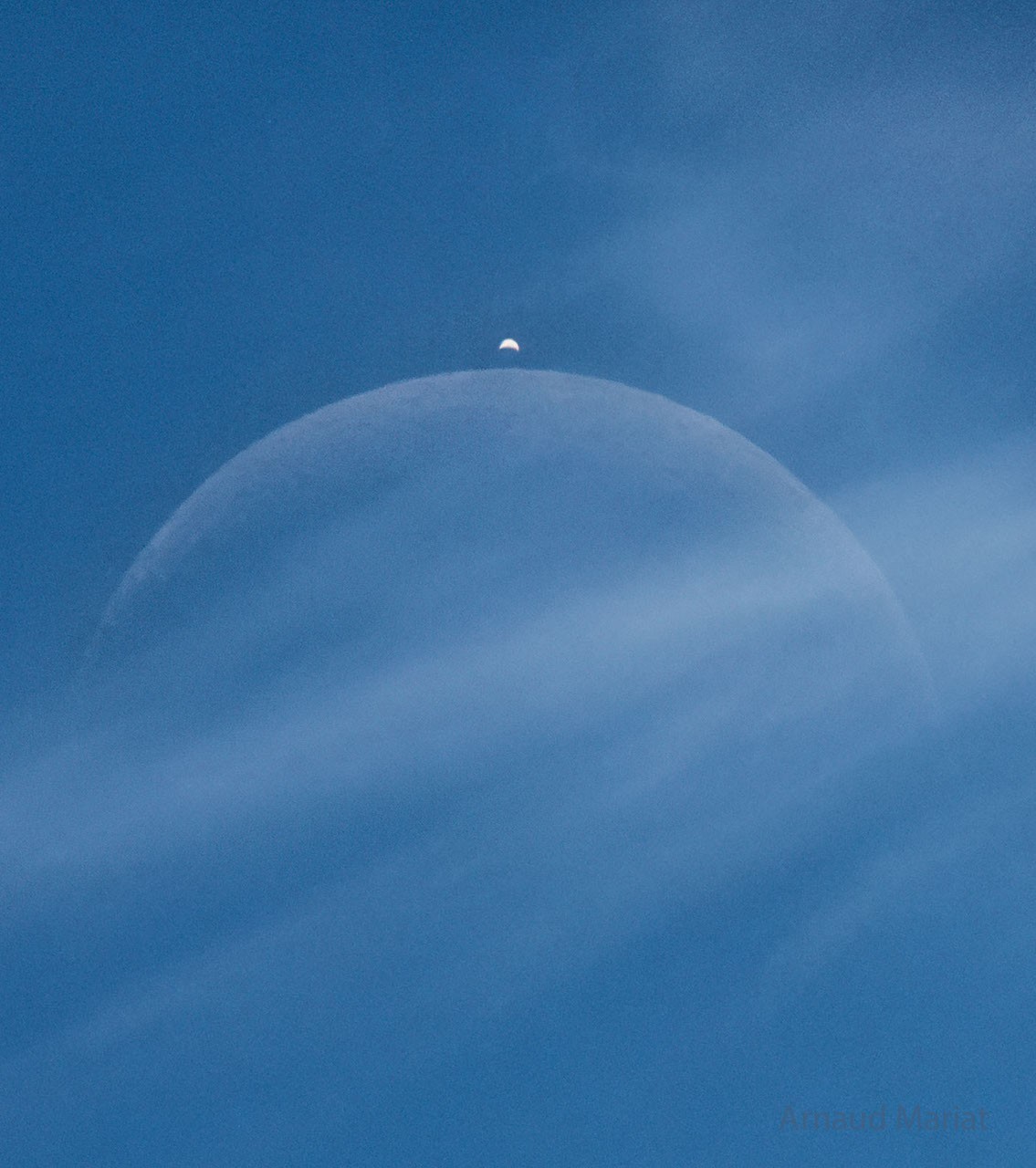
Today, observers experienced a rare daytime lunar occultation, where the Moon passed directly in front of Venus, temporarily obscuring the bright planet from terrestrial view.
Today, the celestial mechanics of our solar system provided a captivating spectacle: a daytime occultation of Venus by the Moon. An occultation occurs when a closer celestial body passes in front of a more distant one, thereby blocking its light. For a brief period today, our Moon, Earth's largest natural satellite, eclipsed the brilliant planet Venus.
Venus, often referred to as Earth's 'sister planet' due to its similar size and mass, is typically visible as a prominent 'star' in the morning or evening twilight. Its exceptional brightness, however, occasionally allows it to be discerned in the daytime sky under optimal conditions. The Moon, being considerably closer to Earth than Venus, appears larger in our sky, enabling it to fully conceal the distant planet during such an alignment.
Astronomical photographic projects, such as NASA's Astronomy Picture of the Day (APOD), frequently feature stunning images and explanations of such phenomena. These events are not merely visually striking; they offer valuable opportunities for scientific observation. For instance, precise timing of occultations can help refine orbital parameters of both the occulting and occulted bodies. Furthermore, if an occulted body has an atmosphere, studying how its light dims and reappears can reveal atmospheric characteristics.
Observing such an event requires careful technique, often involving binoculars or a telescope with appropriate safety filters, as looking directly at the sun (which is also in the daytime sky) can be dangerous. While solar eclipses often capture public imagination, lunar occultations of planets, especially visible during the day, are equally remarkable demonstrations of the dynamic and predictable movements within our cosmic neighborhood. It highlights the intricate dance of heavenly bodies, offering a deeper appreciation for astrophysics and orbital mechanics.
Source: NASA · view original
📚 Create a free account to track your child's reading.