
🔬 ScienceGrades 9 – 12 8 min read
Facts last verified Aug 5, 2026· re-verification due — Checked 112 days ago — due for re-verification.
NASA's PUNCH Mission Revolutionizes Solar Eruption Prediction with Unprecedented Accuracy
NASA's PUNCH mission has achieved a groundbreaking success by precisely predicting the near-Earth arrival of a solar eruption within a 30-minute window, marking a pivotal advancement in space weather forecasting and planetary protection.
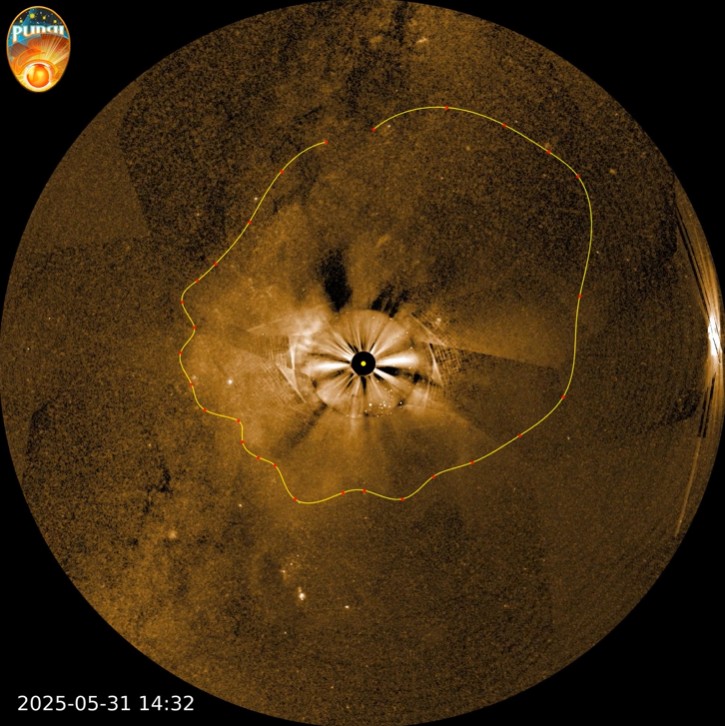
NASA's PUNCH (Polarimeter to Unify the Corona and Heliosphere) mission has demonstrated a significant leap in space weather prediction, fundamentally enhancing our capability to anticipate and prepare for solar events. This innovative mission, comprising four compact satellites, is specifically designed to provide continuous, wide-angle imaging of the Sun's outer corona and the inner heliosphere—the vast expanse where solar winds and coronal mass ejections (CMEs) propagate.
In a crucial initial proof-of-concept test, PUNCH delivered unparalleled observational data that allowed scientists to track a solar eruption, a powerful expulsion of plasma and magnetic field from the Sun's atmosphere. This detailed imagery enabled the prediction of the eruption's arrival near Earth with remarkable precision, achieving an accuracy of within 30 minutes. This level of forecasting detail was presented at the Committee on Space Research Scientific Meeting and is currently undergoing peer review for publication in the journal Space Weather, underscoring its scientific merit.
The implications of this improved predictive capability for Earth-based and space-borne systems are profound. CMEs, when directed towards Earth, can trigger geomagnetic storms. These storms have the potential to induce widespread disruptions, including interference with high-frequency radio communications, degradation of GPS accuracy, and even damage to electrical power grids through induced currents. For example, strong geomagnetic activity can cause widespread power outages, as experienced during the 1989 Quebec blackout. Moreover, they pose radiation risks to astronauts and could damage sensitive electronics on satellites, impacting everything from weather forecasting to global internet connectivity.
Historically, forecasting space weather has been challenging due to the dynamic and often opaque nature of solar phenomena. Previous models relied on less continuous or comprehensive data, leading to broader windows of uncertainty. PUNCH's ability to provide continuous, high-resolution imagery allows for real-time tracking of CMEs from their origin to near-Earth space, offering an unprecedented opportunity to refine models and issue timely warnings. This enhanced foresight allows critical infrastructure operators, such as power grid managers and satellite navigation providers, to implement pre-emptive measures, thereby mitigating potential economic losses and ensuring the resilience of essential services.
This successful initial test firmly positions PUNCH as a cornerstone for future space weather operational forecasting. As the mission continues to collect data, it is expected to further refine our understanding of solar-terrestrial interactions, ultimately strengthening our planetary defense against the unpredictable, yet impactful, phenomena originating from our star. The ability to precisely predict these events represents a significant step towards safeguarding our increasingly technology-dependent world.
Source: NASA · view original
📚 Create a free account to track your child's reading.