
🔬 ScienceGrades 4 – 6 4 min read
Facts last verified Nov 16, 2026 — Next re-verification in 21 days.
Solving the Mystery of Uranus and Neptune
Computer models reveal why our solar system's ice giants have lopsided magnetic fields.
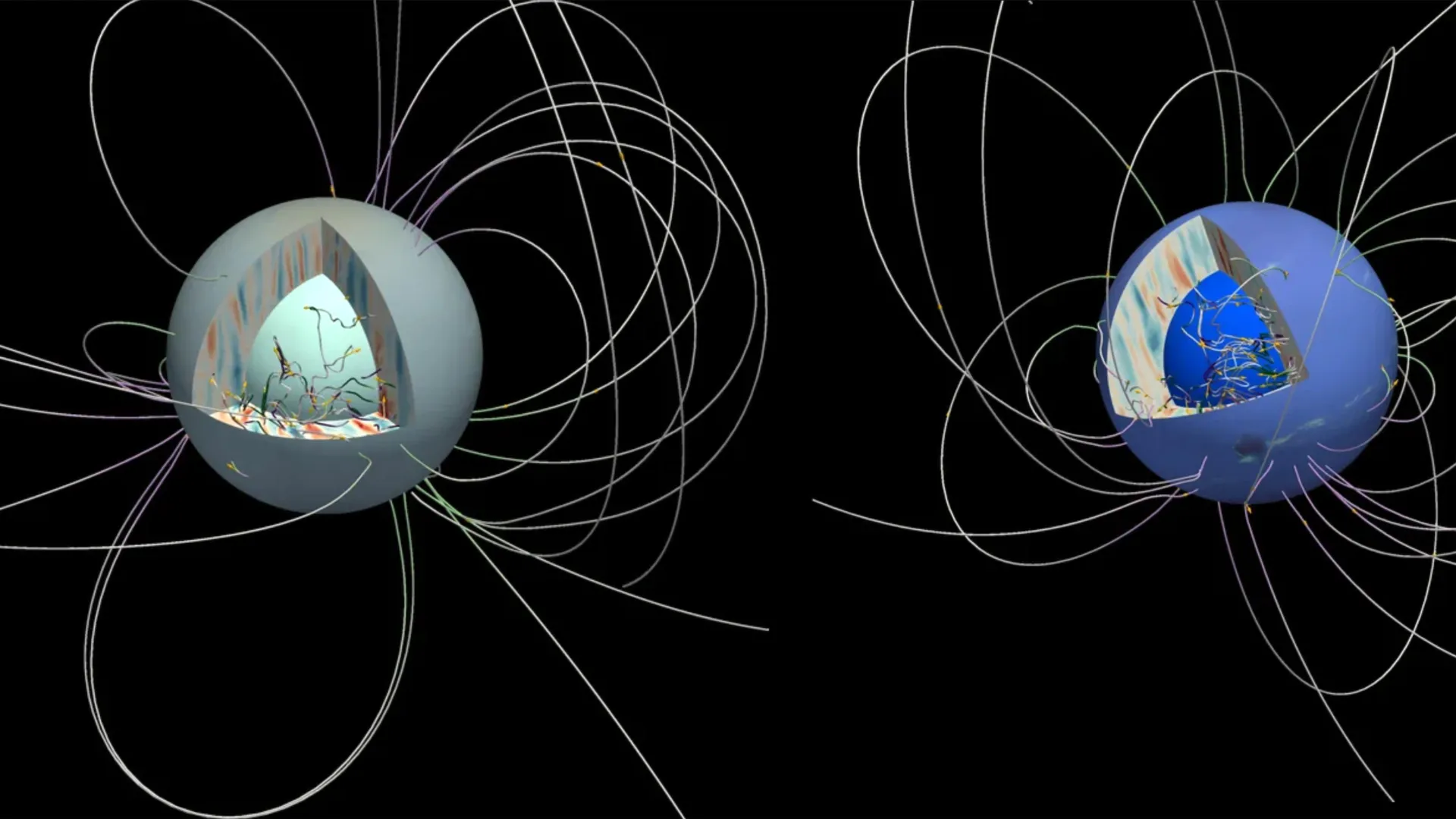
When NASA's Voyager 2 spacecraft flew past Uranus and Neptune in the 1980s, it sent back surprising data. Both planets had bizarre magnetic fields. On Earth, our magnetic north and south poles line up fairly close to the planet's spin axis. But on Uranus and Neptune, the magnetic fields are tipped over at wild angles. They do not even pass through the center of the planets.
For decades, planetary scientists wondered what caused this strange behavior. Now, new computer simulations are offering an answer. Deep within Uranus and Neptune, the conditions are extreme. Crushing pressure and intense heat squeeze water, ammonia, and methane into a dense, slushy liquid. Under these conditions, the liquid conducts electricity in unusual ways.
This churning electric layer creates what scientists call a dynamo. A dynamo is a moving fluid that generates a magnetic field. Because this layer is squished between other thick layers of the planet, the magnetic forces do not form a neat shape like Earth's. Instead, they become crooked and uneven.
The models also show that the magnetic poles on these planets can wander quickly. They could shift by tens of degrees over just a few decades. On Earth, similar shifts take thousands of years.
Why does this matter? Understanding these planets helps astronomers study thousands of worlds outside our solar system. Many exoplanets orbiting distant stars are ice giants just like Uranus and Neptune.
Source: Science Daily · view original
📚 Create a free account to track your child's reading.